Skip to content
Nock AINock Automation

Venture — raising

Retail's theft problem is an architecture problem.

A convenience store built as a machine room. Nothing on a shelf, nothing behind glass. Order at the window; a robot picks it and hands you the box in 34 seconds.
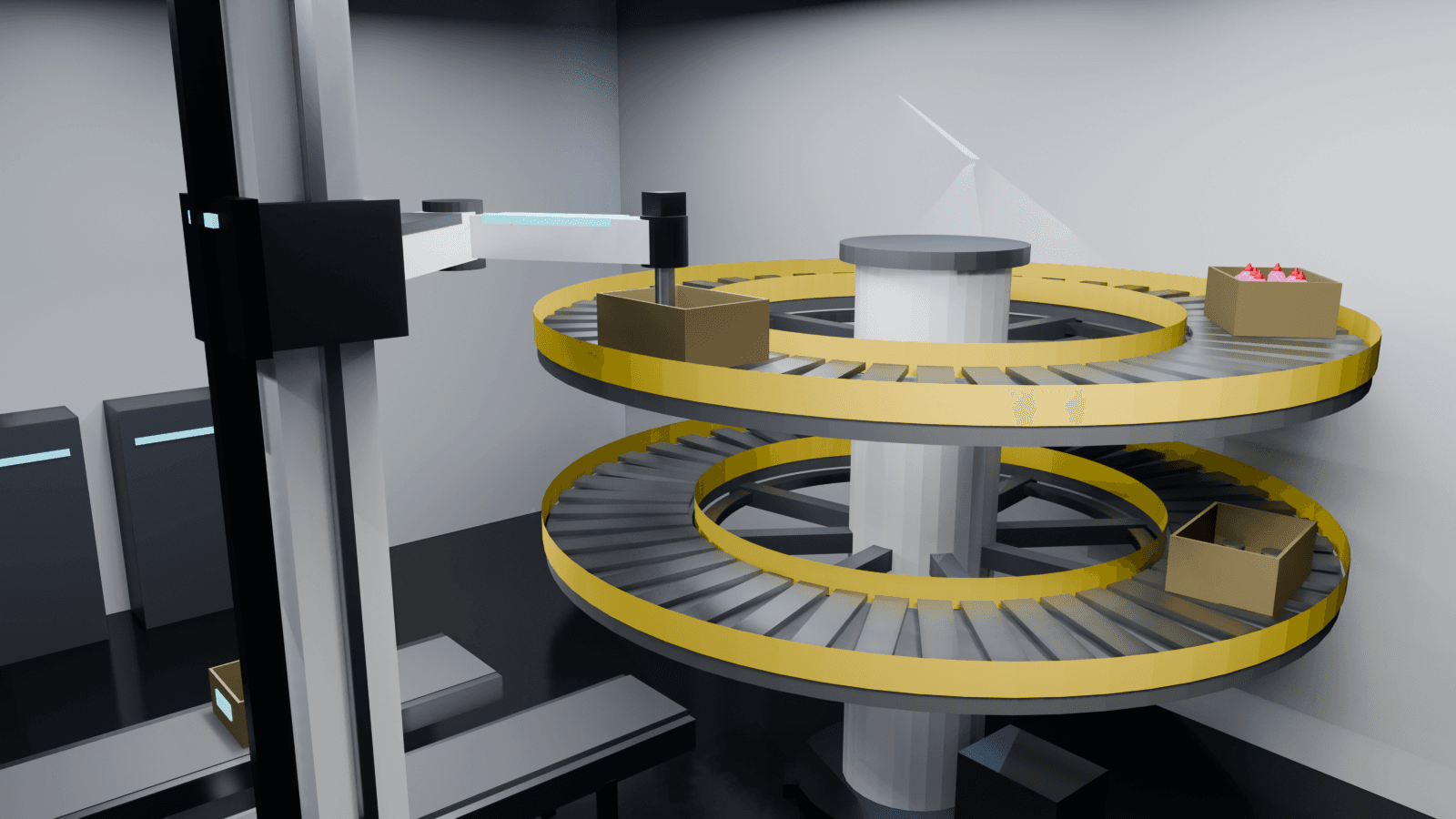
A robotic arm picking an item from a rotating carousel inside the pickup store

drag to look around

Working simulation — the geometry and motion used to validate reach, clearances, and cycle time. Drag to look around.

01 / Problem

The fix costs more than the theft.

Retail answered shrink by locking merchandise in plexiglass. It trades a loss you can measure for a larger one you cannot.

$112.1B

US retail shrink, 1.6% of sales1

15–25%

Sales lost where merchandise is locked up2

55%

Shoppers who leave rather than wait for a key4

+17%

Violence against staff during theft events, YoY6

  • Roughly 2% of customers steal. The countermeasure is applied to 100% of them.2
  • Walgreens’ CEO told investors the approach was backfiring — and kept the cases.3
  • One in three shoppers abandons the purchase or switches retailer.5
  • 48% of retailers admit their own security measures damaged the customer experience.7

02 / Consequence

The format is not underperforming. It is closing.

~1,250

Rite Aid stores liquidated9

~1,200

Walgreens closures planned4

~50M

Americans in a pharmacy desert — 1 in 78,10

146%

Annual c-store associate turnover11

Demand did not disappear with the stores. It moved to delivery apps and to neighbourhoods that no longer have a pharmacy at nine at night.
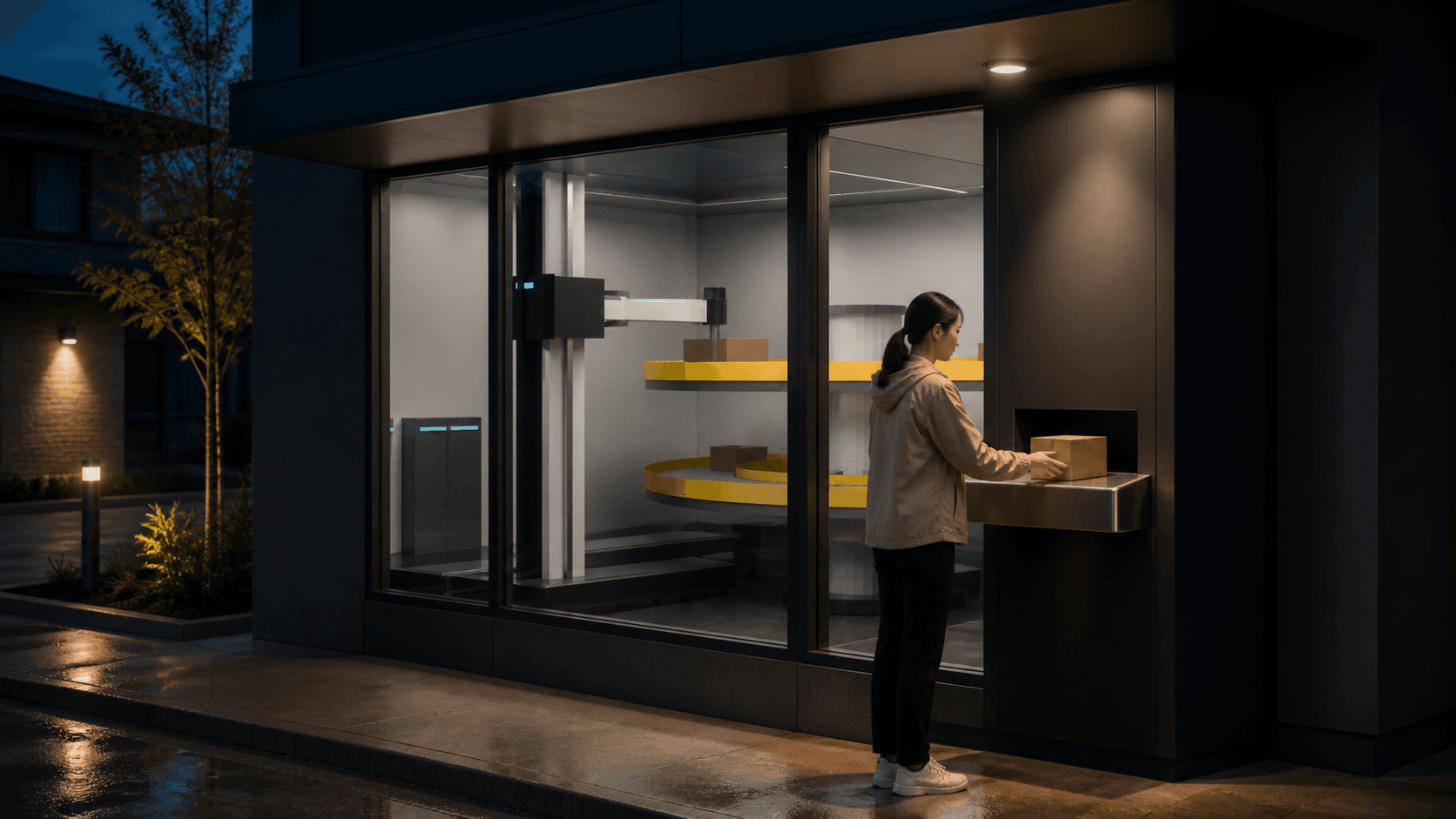
A customer collecting a boxed order from the exterior pickup window of a compact autonomous store at night
The customer-facing store is a window, not an aisle: order outside, collect outside, and keep every item behind the glass. Concept visualization.

03 / Solution

Put the merchandise where hands cannot reach it.

  1. 01Order at the window. The customer never enters the building.
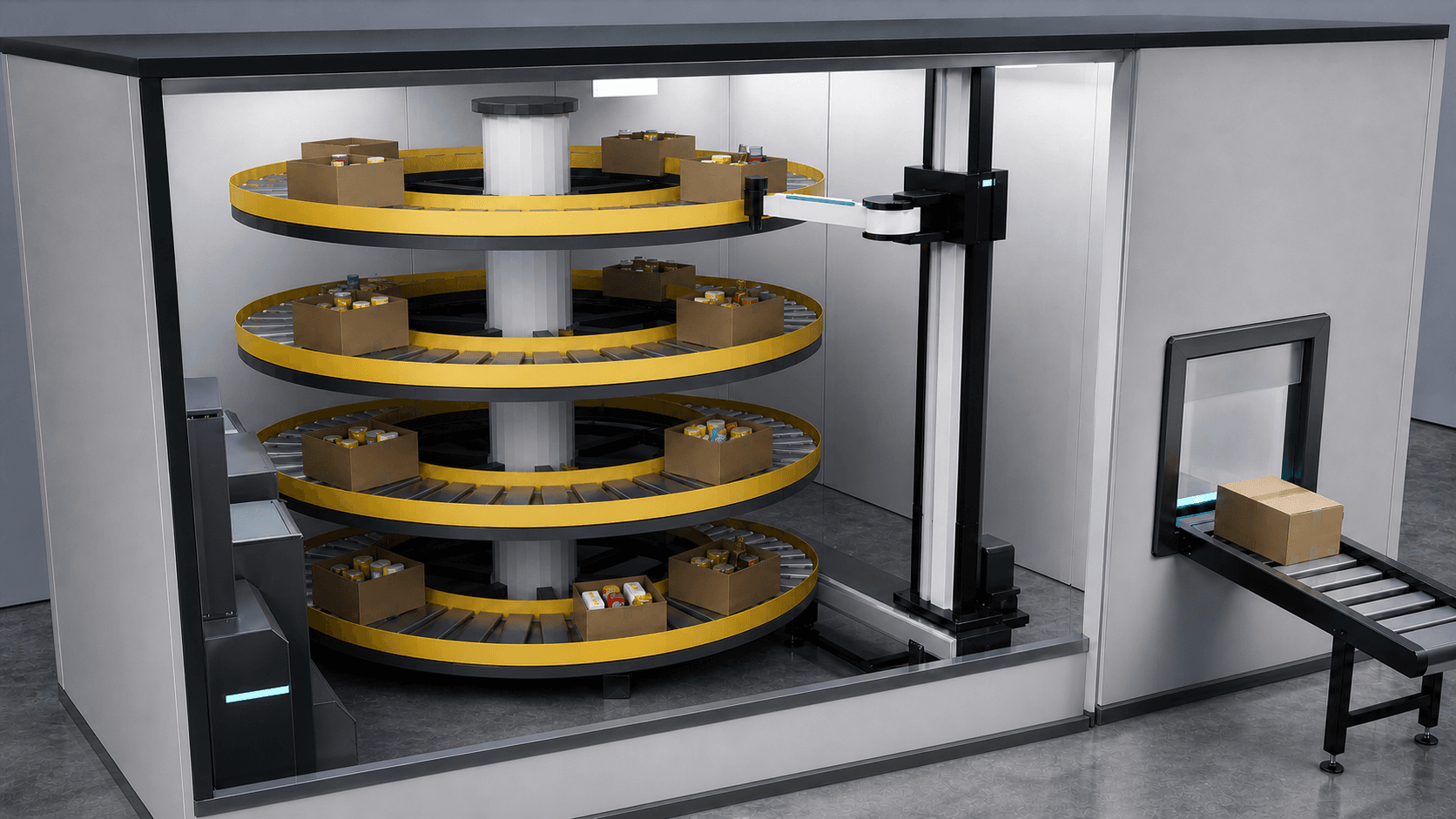
  2. 02Stock rides stacked rotating carousels. Nothing is within public reach.
  3. 03A lift-mounted arm picks individual items into an order box.
  4. 04The box travels out through a delivery window to the tray.
Cutaway view of a compact robotic picking cell with four tightly stacked yellow carousel belts, inventory totes, a lift-mounted arm, and an outfeed conveyor
Inside the machine room, carousel storage brings the tote to one fixed pick station; the arm and outfeed only solve a bounded path. Concept visualization.

04 / Product

Four moves. 34 seconds.

01

Order

Phone or kiosk at the glass. No aisle, no cabinet, no queue.

02

Present

The carousel indexes the right tote to the pick station and stops.

03

Pick

A vertical quill reaches into an open tote and takes the item.

04

Deliver

Packed box travels the outfeed, through the window, to the tray.

05 / Unit economics
Four levers. One is structural.

Shrink
Structurally near zero
No open shelf to sweep, no cabinet to defeat. Falls out of the architecture, not operating skill.
Labor
Restock and service only
Labor is the sector's largest operating expense. We remove the shift, not the person.11
Footprint
Machine room, not showroom
No aisles, no browsing space, no lanes. Vertical storage in a fraction of the floor area.
Hours
24/7, no night shift
Cashierless wins where staffing the hours was already uneconomic. Nights carry the margin.12
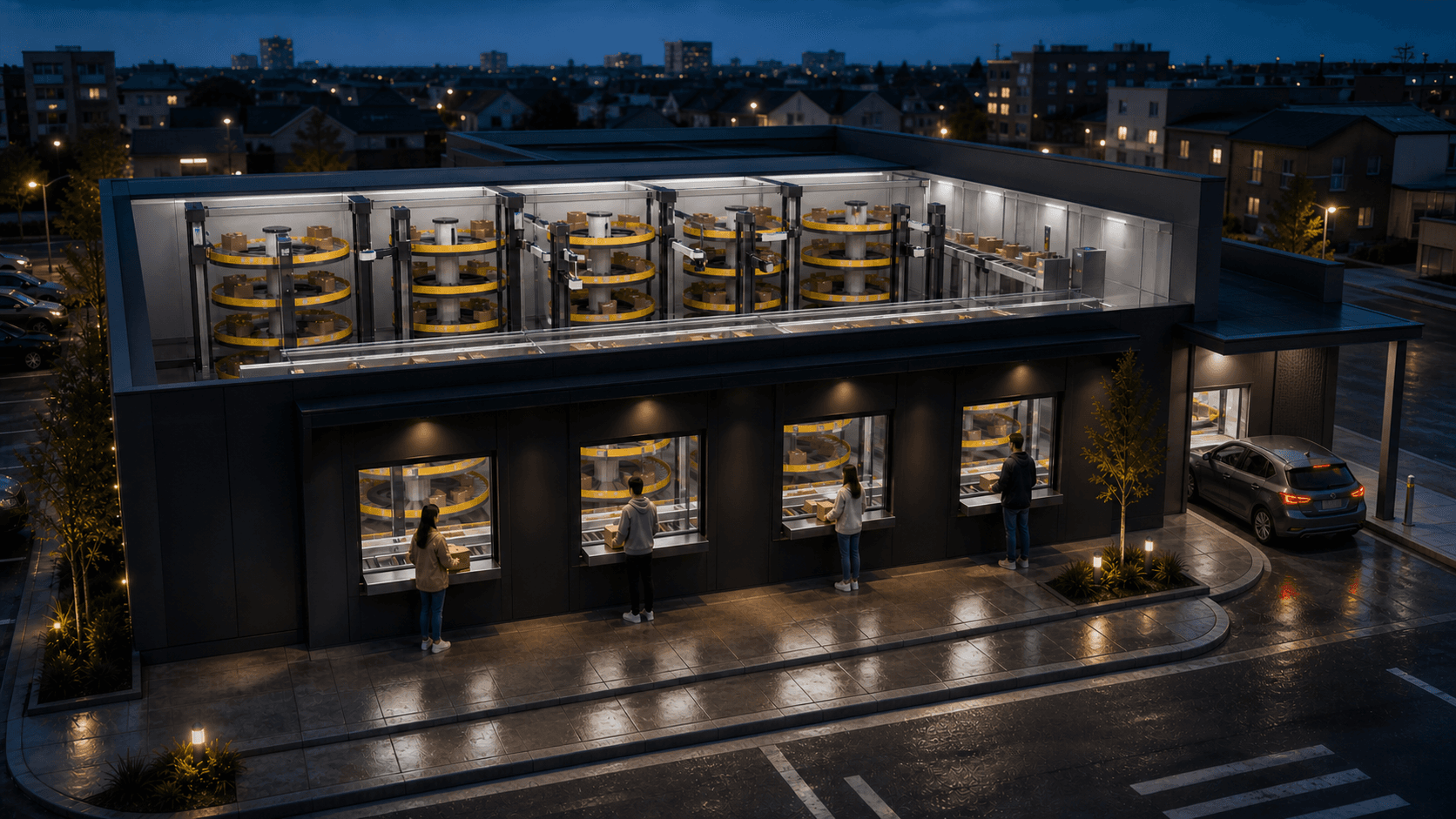
A pharmacy-scale autonomous store with multiple four-belt carousel cells feeding four walk-up windows and a covered drive-through pickup lane
Store scale is modular: repeat the four-belt cell, run picks in parallel, and consolidate orders onto a shared outfeed serving walk-up and drive-through pickup. Concept visualization.

06 / Why now

Sites are cheap. Robots got fundable.

$19.6B → $39.1B

Automated retail market, today to 203314

$18.8B

Robotics venture funding in H1 2026 — above all of 202515

2,000+

Net US pharmacy locations lost in five years8,9

07 / Competition

Amazon proved where this fails. We are not doing that.

Just Walk Out

Pulled from Amazon Fresh in 2024. It inferred what an unconstrained crowd did with unconstrained merchandise at grocery scale. Sensing scaled worse than the store.12

Where it survives

Stadiums, campuses, hospitals, travel hubs — small format, bounded assortment, hours that were uneconomic to staff. That is our target profile exactly.12

VenHub

Nasdaq-listed, five stores running in Los Angeles. Evidence the category is fundable — not evidence the space is empty.13

The difference is the order. The customer states it, the machine picks against it, the transaction closes before the box leaves the building. There is no crowd to track and nothing to guess.

08 / Status

Where this actually is.

Built
Full kinematic simulation — reach envelope, quill stroke, rim clearances, carousel indexing, cycle time. All solved and verified.
Measured
34s order-to-window, single arm, three items, two carousel decks. Simulated, not bench-tested.
Not built
No hardware. No pilot site. No revenue.
Next
One physical single-bay cell: arm, one carousel deck, one window. Prove the pick rate on real product.

09 / The ask

Fund the first physical cell.

Round size and terms on request. Capital goes to hardware and a pilot site, not to more renders.

  1. 01

    Single-bay cell

    Arm, one carousel deck, one window. Pick rate and reliability on real product.

  2. 02

    Pilot site

    One location in a closure-affected trade area. Real orders, real hours, real basket data.

  3. 03

    Unit model

    Capex per bay, picks per hour, uptime, restock labour. The numbers that decide whether this scales.

Appendix
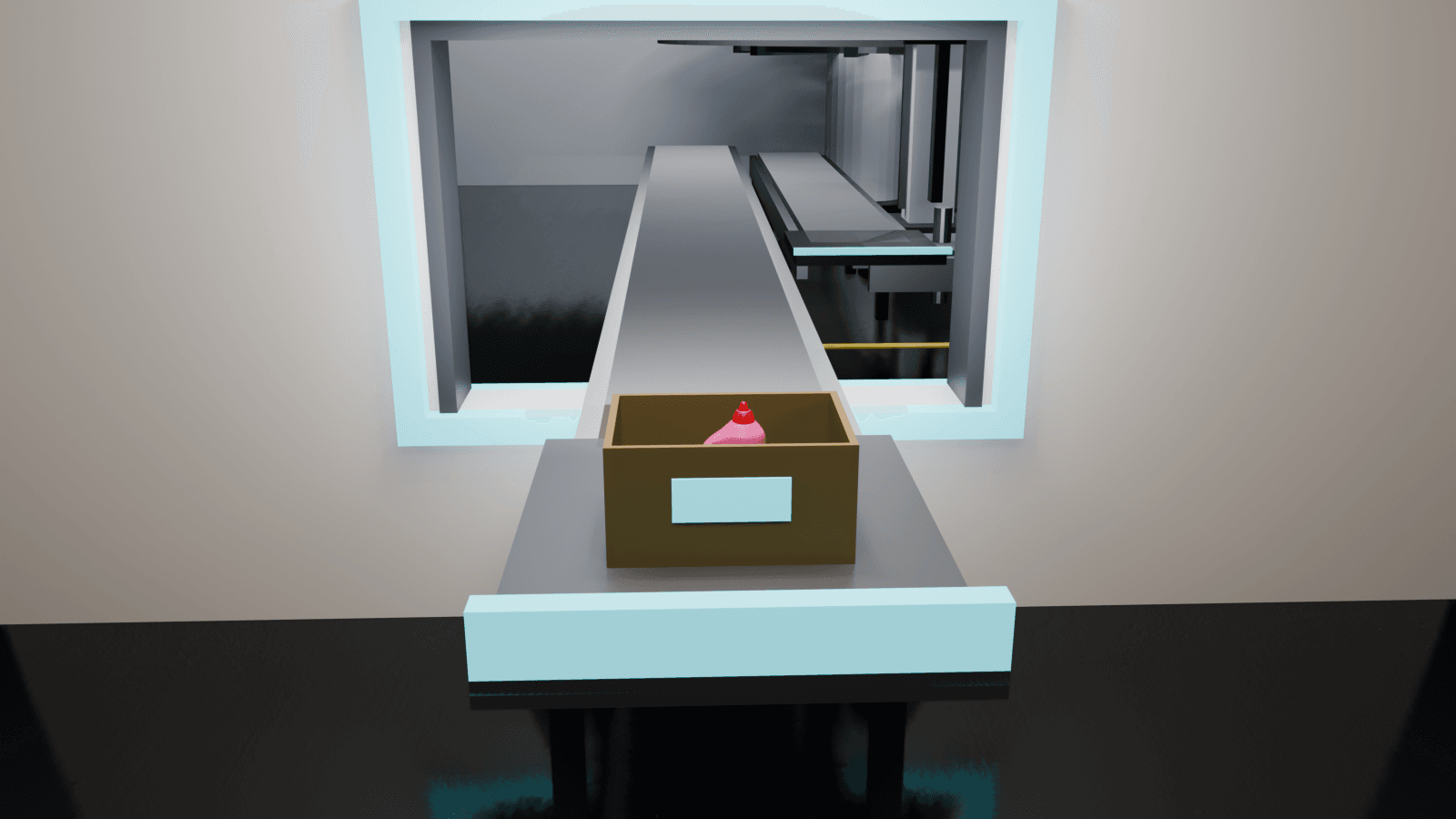
From the simulation

Full cycle. Box reaches the window at 34 seconds; 37 seconds of footage, real time.
The arm reaching into an open tote on the upper carousel deck
The packed order box waiting on the tray at the customer window

References

Every figure, traced.

  1. [1] NRF National Retail Security Survey — shrink at $112.1B, 1.6% of sales (opens in a new tab)
  2. [2] Axios Locking up items to deter shoplifting is pushing shoppers online (opens in a new tab)
  3. [3] CNN Business Walgreens admits locking up products hurts sales (opens in a new tab)
  4. [4] Axios Chicago Consumer World survey; Walgreens closure plan (opens in a new tab)
  5. [5] Moneywise Numerator survey — one in three abandon or switch (opens in a new tab)
  6. [6] NRF The Impact of Retail Theft & Violence 2025 (opens in a new tab)
  7. [7] ASIS External theft incidents increased 19 percent in 2024 (opens in a new tab)
  8. [8] STAT News Pharmacy deserts and accelerating closures (opens in a new tab)
  9. [9] VytlOne Pharmacy Deserts: An Update for 2026 — closures by chain (opens in a new tab)
  10. [10] The National Desk Nearly 50 million Americans live in pharmacy deserts (opens in a new tab)
  11. [11] Convenience Store News 2025 Industry Report — labor costs, 146% associate turnover (opens in a new tab)
  12. [12] Retail TouchPoints Amazon pulls Just Walk Out from Fresh; autonomous retail grows elsewhere (opens in a new tab)
  13. [13] C-Store Dive VenHub's robotic convenience stores (opens in a new tab)
  14. [14] U.S. Chamber (CO—) Automated retail market sizing, citing IMARC Group (opens in a new tab)
  15. [15] Crunchbase News Robotics venture funding surges in 2026 (opens in a new tab)

Shrink figures come from industry self-reporting and are contested — the NRF withdrew its long-running shrink survey in 2024 over methodology, and some store-closure rationales have not matched local crime data.3 We cite them because they drive retailer behaviour, which is what this business responds to.

Request the deck

Tell us where the hours go.

No pitch required.

Name the team and what the work costs them in a week. That is enough for us to tell you whether we are useful.

Get in touch